Akava’s parliamentary election goals

At Akava, we think that Finland’s future will be built on the knowhow of experts. Our aim is for Finland to become a society based on strong expertise and education, since sustainable economic growth is founded on solid competence and employment as well as on a satisfying and safe working life.
Akava’s parliamentary election goals
From the President
Without experts, Finland will come to a halt.
At Akava, we think that Finland’s future will be built on the knowhow of experts. Our aim is for Finland to become a society based on strong expertise and education, since sustainable economic growth is founded on solid competence and employment as well as on a satisfying and safe working life.
The road to success begins with thought.
Competent and innovative people and companies capable of renewal create growth. The best return on our shared finances is provided by higher education. It nurtures human capital, improves productivity and supports longer careers.
Higher education and research are essential for growth and renewal in international competition. They provide companies and the public sector with the necessary competent workforce. They facilitate investments, create jobs and strengthen regional vitality. High-quality higher education and research require far-reaching decisions and strategic investments.
New information and new ideas must translate into evolving products and services. Every employee educated or working in Finland can strengthen our nation’s ability to develop and commercialise new products and innovations, and improve our productivity.
Thriving employees generate a productive working life that creates sustainable growth. For work to give more than it takes, workplaces need clear responsibilities and good leadership. A satisfying working life carries and supports – both the individual and our society.
Fairness is the foundation of Finnish working life. Career development must be possible regardless of family leaves. Employee rights and security must be realised even in temp work. When discrimination is prevented and the position of fixed-term employees is improved, working life becomes more just. Dismissals should not be too easy to implement.
A stable labour market requires a functional mediation system and up-to-date information. Discussion and negotiation triumph over confrontation. When security to cover interruptions in work careers and the employment pension policy are developed in collaboration, trust grows stronger throughout careers and across generations.
Finland has been successful before – and can be again. This is why we propose solutions that reintroduce thinking, research and expertise to the core of our success. When we commit to nurturing them, our future is full of possibilities.
We will not let Finland come to a halt.
Think.
Maria Löfgren
President, Akava
Growth and education

Without experts, Finland will come to a halt. Think.
Growth is born out of thought. Finland needs new ideas and new expertise. Science, research and education breed innovations that create well-being, culture and sustainable growth. Growth is built by raising our education and competence level to a leading international level, by investing in higher education institutions and research and by ensuring the incentives for working.
Akava’s solution
The quality of higher education should be improved by strengthening core funding, streamlining access to higher education and ensuring the employment potential of higher education.
The quality of higher education should be improved by strengthening core funding, streamlining access to higher education and ensuring the employment potential of higher education.
A parliamentary working group should be set up to draft a plan to raise our competence and education standard to a leading international level. This work should draw on the experiences from the work of the parliamentary RDI working group. The working group should also define the milestones and indicators for Government terms in order to monitor the progress towards achieving the goal.
The financing and steering system of higher education institutions should be reformed to support their specialisation and employment potential, and emphasise quality as a steering criterion to replace the current results-based approach.An index guarantee should be implemented to strengthen core funding.
Access to higher education should be streamlined.Higher education institutions should be encouraged to mould the currently fragmented course provision during the transition phase (e.g. open university, path studies) into field-specific study modules that are common to all higher education institutions. Young people without a student place in further studies and groups that are underrepresented in higher education should be guided towards them.
The functionality of the education and training voucher pilot should be assessed and practices that hasten access to higher education made permanent.
The employment potential of the highly-educated should be increased by making the costs related to developing expertise tax-deductible like other expenses for the production of income.
The possibility of creating a public-private partnership project in Finland in accordance with the Danish model should be clarified: a Pact for Skills with the aim of one million AI experts.
Reasoning
Finland’s education level can be turned to an upward trend
The share of young adults with a higher education degree in Finland is lower than the OECD average. In order to turn the situation around, we need a parliamentary long-term plan, with the aim of streamlining access to higher education, reducing drop-out numbers and hastening degree completion. The plan would also support economic and employment growth.
Higher quality for the higher education financing and steering system
Sufficient and predictable core funding, an index guarantee and the strengthening of qualitative indicators are necessary to secure the quality of education. This will ensure the strategic benefits higher education brings to the individual and society.
A changing working life requires constant competence development
Technological development, the green transition and rapidly increasing AI use are changing competence requirements. We need a competence leap to keep up with international development. We need new incentives to support constant learning, such as wider tax deduction rights for competence development costs and broader study possibilities for the unemployed.
Highest yield?
Higher education.
Think.
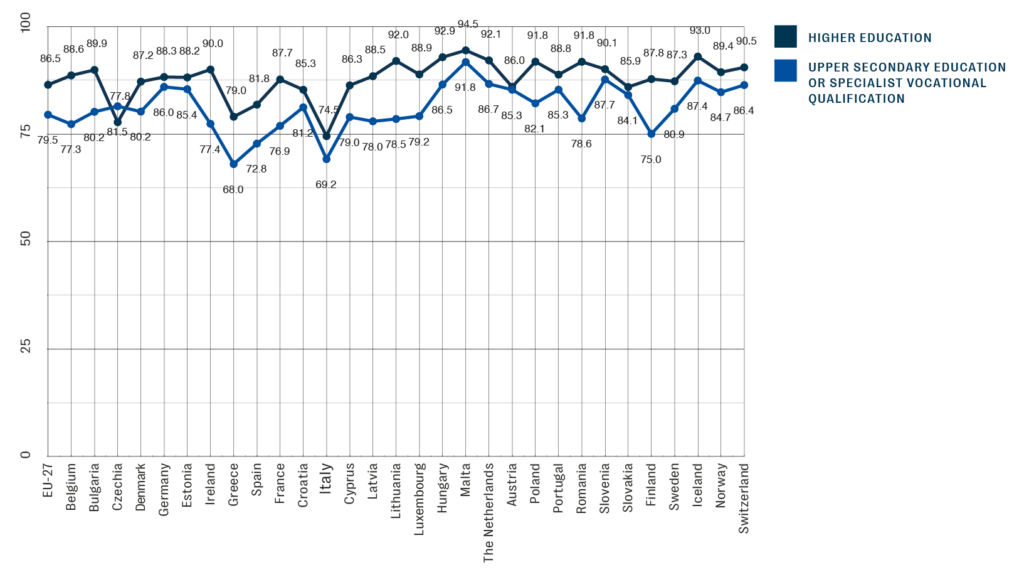
Employment rates for people aged 25–34 with upper secondary and higher education in EU and ETA countries in 2024
Akava’s solution
The prerequisites for higher education institutions and research should be improved
The financial autonomy of higher education institutions should be strengthened, thus improving the capability of higher education institutions to raise the education and competence level. The R&D funding for basic and applied research should be significantly increased in 2028–2030 and higher education funding raised to the EUR 10 billion level through exploitation of the State’s company ownerships.This will support the long-term renewal of the economy and strengthen the freedom of science, art, research and teaching.
Low-threshold RDI programmes for SMEs should be created, in which higher education institutions work as intermediate organisations and the financing encourages long-term collaboration. Shared infrastructures should also be built.
Reasoning
Strong investments in education and research improve Finnish well-being.
Increased human capital and strengthened RDI investments facilitate the most sustainable economic growth. Without additional investments in education, research and foreign experts, Finland’s overall production may suffer in the long term.
Higher education institutions’ financial autonomy supports innovation and renewal.
Sufficient financial resources for higher education institutions mean financial autonomy, which will strengthen the quality and impact of research, increase the possibilities of agile reaction to changes in competence needs, and support international competitiveness and long-term RDI activities.
Thinking will lift Finland to growth.
Think.

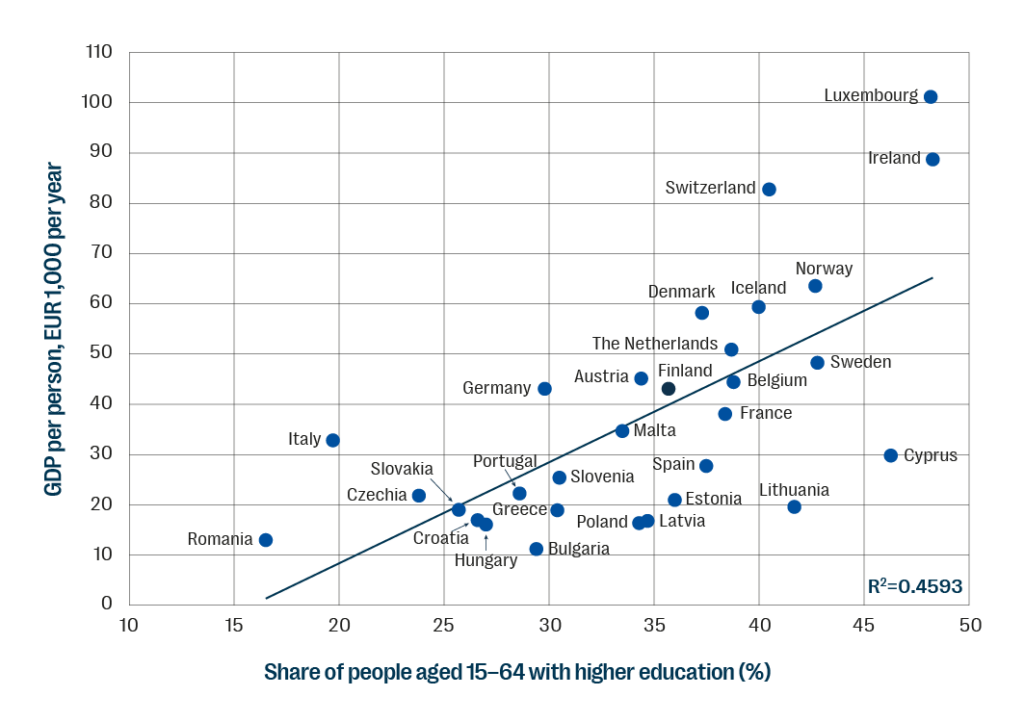
Finland does not grow through machines alone, but through thought.
GDP/person and share of people with higher education in EU and ETA countries in 2024
The core funding for higher education has not increased in line with the rise in student numbers and added tasks.
Costs per student in Finland are down -13.5%
In other OECD countries, the costs are up +8.6%
Finland does not grow through machines alone, but through thought.
Akava’s solution
Companies should be supported to renew and hire experts
The business subsidy system should be reformed to strengthen company growth, renewal and RDI activities, and to promote intangible investments and the green transition. Preservation-oriented subsidies should be trimmed, the position of growth companies as subsidy recipients strengthened and the share of loans in the business subsidy system increased. A points-based model for business subsidies should be created to place more emphasis on projects that produce results and ideas with the potential to spread widely into other businesses, sectors, the entire innovation system or society rather than staying within the company.
Income tax progression should be eased to increase incentives for extra work, better work performance and career progress. The membership fees of labour market organisations must be tax-deductible in the future.
Finland’s appeal should be improved to attract and commit more international experts to Finland. It is essential to improve the preconditions for building a stable life, such as psychological safety, i.a., by creating a faster track for a permanent residence permit, for example, through the implementation of a points-based model to assess integration and competence potential.
Reasoning
Business subsidies can benefit society much more than they currently do if they are built and allocated in a new way.
The current business subsidy system does not nearly always promote the growth opportunities of the national economy or speed up corporate renewal, the creation of new ideas or RDI activities. Too often, the subsidies are granted to large and already profitable companies. By using different forms of subsidies in a versatile manner and assigning points to subsidised projects based on externalities we can improve the allocation of subsidies, which will benefit the entire society more broadly and provide an opportunity to save public funds.
Strict income tax progression destroys the incentives for work, education, career progress and the development of new ideas.
In Finland, income taxation gets strict fast at a relatively low income level, which weakens the desire to progress in one’s career, develop expertise and take on responsibility. Easing progression improves the incentives for work and entrepreneurship, supports the possibilities of companies to reward competence and sends a strong signal that Finland is a competitive operational environment for competence-intensive businesses.
Finland needs a stable and predictable immigration policy, so that people dare to build a life here.
The growth of the working-age population and economic success stories require immigration, but the current permit system breeds uncertainty that weakens commitment to Finland. A points-based fast track to a permanent residence permit would improve psychological safety, encourage integration and strengthen Finland’s ability to attract and above all commit international experts.
In 2024, companies were granted around EUR 1.1 billion in unconditional benefits. About half of that went to major corporations. During the same timeframe, loans granted amounted to EUR 300 million.
Source: Kuosmanen: business subsidies and the reform of business subsidy system, Akava Works

An increase of 10,000 persons per annum in work-based immigration would alleviate the financial pressure on the economy by around EUR 1.4 billion.
Source: Ministry of Finance’s sustainability calculations
Without experts, Finland will come to a halt. Think.
Working life and labour markets
Work is productive when responsibilities are clear, harmful loading is prevented and the quality of working life is secured. The productivity of work improves when co-operation is smooth, there is an atmosphere of trust in the workplace, and the organisation’s top management supports the possibilities of employees and work communities to utilise their full potential. Well-being at work, competence, equality, good leadership and functional labour markets make this possible.
Akava’s solution
The current Occupational Safety and Health Act should be specified and a new decree on psychosocial workload issued. The position and responsibilities of supervisors should be clarified and the grounds for a corporate fine strengthened.
Occupational safety and health legislation should be updated to correspond to changes in working life. An employer’s responsibility for the prevention and management of psychosocial workload must be specified. The decree should clarify what kinds of factors related to the content and organisation of work and the activities of the work community can cause loading. It should also define how these factors are monitored, assessed, processed and prevented.
The responsibilities and mandates of supervisors for occupational safety and health should be clarified in relation to the employer, and the sanction system for occupational safety and health reformed by strengthening the grounds for a corporate fine. A supervisor should not be held personally responsible if they have tried to act with care but the employer has not provided adequate resources or support. This will strengthen the legal protection of supervisors and the realisation of employer obligations.
Reasoning
Psychosocial workload refers to psychological and social factors present in the work, such as issues related to the nature of the work, work arrangements, interaction and the functionality of the work community, which may cause harmful loading or expose employees to adverse effects on health and wellbeing.
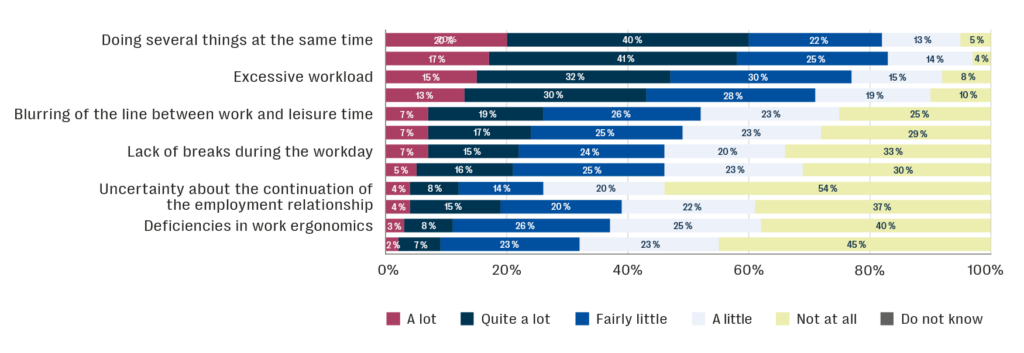
The increasing intensity of work, changes in working life and increased harmful psychosocial workload form a significant risk to health and work ability.
Psychosocial risks are just as serious as physical ones. The employer has a legal obligation to ensure that the work does not endanger the health of employees. Without detailed legislation and development of management, an increasing number of employees are at risk of a decline in work ability.
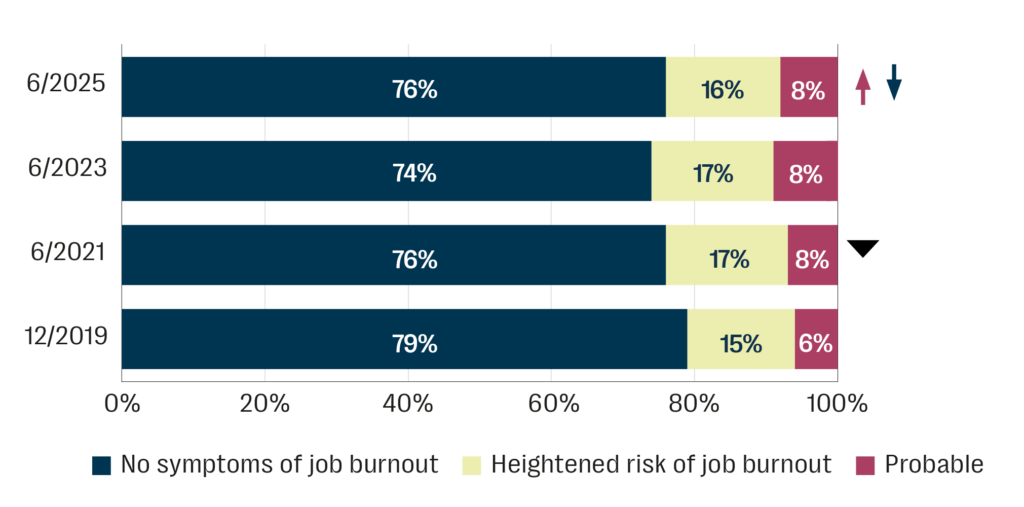
Job burnout risk groups
How much of a risk do you consider burnout to be in your work? (n=2002)
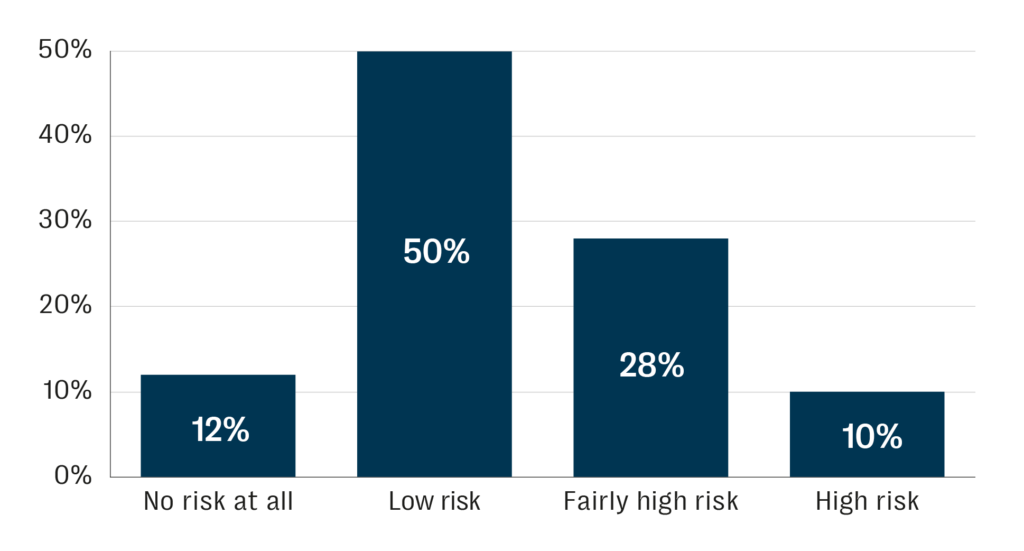
Source: https://akavaworks.fi/kysely/tyoolotutkimus-2024/

Reasoning
Clear regulation that defines which factors related to the nature of work, work arrangements and the functioning of the work community may cause loading supports the realisation of the employer’s obligation. In addition, systematic prevention and monitoring help to identify load factors before they lead to disability.
Occupational safety and health and wellbeing at work are the employer’s statutory obligations and the responsibility of the legal person. Clarifying the responsibilities improves the legal protection of supervisors, and strengthening the grounds for a corporate fine directs the organisation towards responsible operations.
According to research by Akava Works and the Finnish Institute of Occupational Health:
10% of Finns suffer from probable job burnout
15–30% are struggling with a clearly heightened risk of job burnout.
How much harmful loading do the following factors cause in your work?
Akava’s solution
The increasing commonality of expert work should be recognised and work legislation amended to correspond to changes in the ways of working
The Act on Occupational Safety and Health Enforcement and Cooperation on Occupational Safety and Health at Workplaces should be amended to correspond to changes in working. The Act on Occupational Safety and Health Enforcement and Cooperation on Occupational Safety and Health at Workplaces should be specified as concerns agreement on remote work practices and an employee’s right to detach themselves from work duties and be digitally unreachable outside of working time. Guidelines concerning detachment from work duties and unreachability during leisure time should be agreed on as part of occupational safety and health cooperation.
The Workers’ Compensation Act should be expanded to include accidents that occur during remote work.
Reasoning
Remote work, hybrid work and multi-location work have become more common in Finland. Thanks to digitalisation, expert work, in particular, is increasingly less tied to location or time.
It is important for workplaces to find the modes of hybrid work that best suit the organisation. Within the workplace, the rules of remote work need to be discussed with the personnel and the best solutions need to be built together, so that the time and the place of doing the work serve and support both employer and employee, the work itself and its productivity and safety.
According to data from the mandatory labour force survey in EU countries, work is done at home relatively frequently in Finland and other Nordic countries. Eurostat publishes the share of persons working from home, with Finland ranking in the top five in the past years. Like in other Nordic countries, hybrid work is common in Finland.
Since the application of the Workers’ Compensation Act to remote work is highly subject to interpretation, the legislation should be specified to ensure the safety of remote work.
Akava’s solution
The position of fixed-term employees should be improved and pregnancy and family leave discrimination reduced and prevented
The Employment Contracts Act should be amended so that hiring a new employee for the first time on a fixed-term contract lasting no more than a year on the employer’s initiative without a justified reason would no longer be possible.
The Employment Contracts Act should be amended so that the employee is entitled to terminate a fixed-term contract of longer than six months.
Legislation should be strengthened so that fixed-term employment relationships include the possibility of developing competence during the relationship.
It should be ensured that pregnancy or family leave do not influence the terms of an employment relationship or its continuity. The law should be specified so that the taking of a pregnancy or family leave is not allowed to influence whether a fixed-term employment contract is made or its duration continued. A reversed burden of proof should be decreed for discrimination situations concerning fixed-term contracts and the return from family leave.
Employees returning from a family leave should be guaranteed increased protection against dismissal, the length of which is relative to the length of the family leave.
A 60-day earnings-related unemployment security, granted based on six months of employment, should be implemented.
In order to receive earnings-related unemployment allowance, an employee that has become unemployed currently has to meet a 12-month employment condition. In fixed-term employment and especially at the start of a career, meeting this condition is too demanding for many. Unemployment security could be improved by implementing a short-term earnings benefit that could be granted based on a shorter period of employment.
Reasoning
The share of employees in fixed-term employment relationships is higher in Finland than in several other EU countries. In Finland, the share is the fifth highest among the EU countries.
The impacts of unjustified fixed-term employment relationships on employment and the economy are small, but they have significant negative impacts on both the individual employee and the society as a whole. A long fixed-term employment relationship may prevent the employee from getting a new, permanent employment relationship. Information about a pregnancy may also influence the receipt of a new fixed-term contract.
Pregnancy and family leave discrimination is one of the most significant equality issues within the Finnish labour market. Such discrimination is especially prevalent in fixed-term employment relationships, and the problem has not been eliminated or alleviated despite the current prohibition on discrimination.
Family leave discrimination is a problem for both the employee and the labour market. Discrimination based on the use of a family leave lengthens periods of absence from the labour market, causes breaks in careers and weakens the income level. An employee returning from family leave should have increased protection against dismissal, as during pregnancy or family leave. The protection should be relative to the length of the family leave.
Discrimination should be decreased by reforming legislation. Current legislation does not provide adequate protection to pregnant employees or employees returning from family leave. Not everyone has the desire or courage to take even the clearest cases of discrimination forward. Legal remedies are slow, and employees dare not use them for fear of stigmatisation or hindering their employment or career progress.
Pregnancy discrimination in Finland
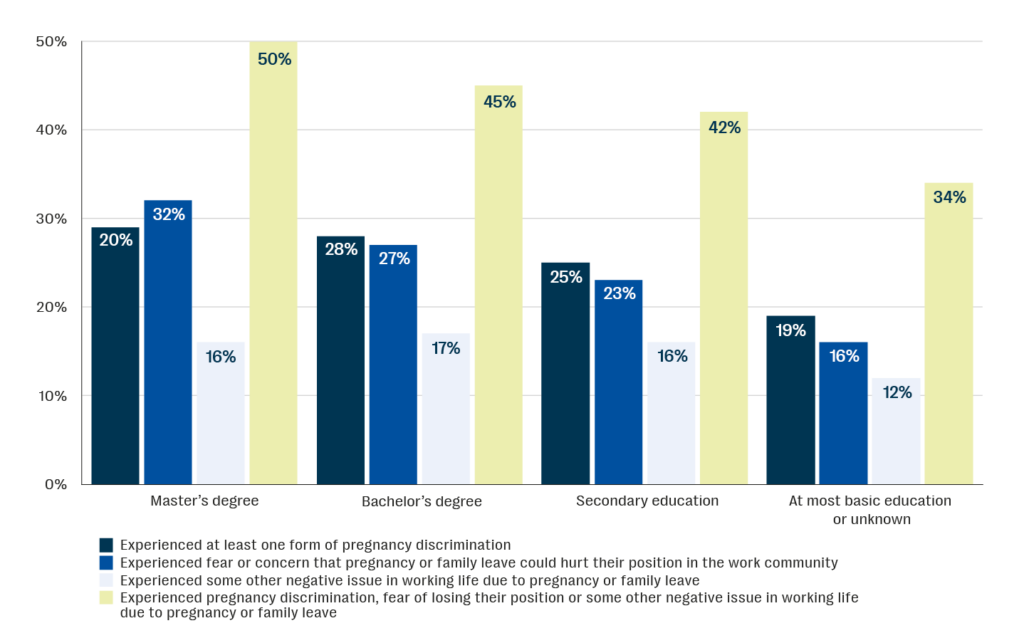
Experiences of pregnancy discrimination, fear or other negative issues related to pregnancy in connection with pregnancy or family leave, % of pregnant employees during 2012–2023 per current level of education. N = 5,436. Source: Pregnancy discrimination in Finland: Statistical survey 2024. Reports and Memorandums of the Ministry of Social Affairs and Health 2024:20
Akava’s solution
Compensation for groundless termination of an employment contract should be increased to 6–30 months
The compensation payable to the employee for the groundless termination of an employment contract should be raised to 6–30 months. The compensation payable to a personnel representative should be raised correspondingly to 36 months.
Reasoning
Protection against dismissal on person-related grounds has been weakened and the uncertainty of working life has grown. The legal state as concerns a proper reason for termination will remain unclear for a long time.
In Finland, the compensation level for unjustified termination of an employment contract is, based on practice, too low and, as a result, its preventive impact limited. The sanctions for groundless termination of an employment contract are a part of an employee’s employment protection, protecting them against unjustified termination of employment.
When the threshold for person-related termination is lowered, the risk of unjustified terminations, erroneous interpretations of new regulation and discriminatory dismissals shrouded in other reasons increases. An adequately efficient compensation system works as a balancing legal protection measure that prevents abuse.
Raising the compensation for groundless termination of an employment contract, as specified in Chapter 12, Section 2 of the Employment Contracts Act, would strengthen the preventive impact of the regulation.
The proposed changes strengthen employees’ employment protection and position as the weaker party in an employment relationship and, thus, improve labour market balance.
Akava’s solution
The sanction system should be balanced as concerns compliance with general collective agreements. The compensatory fines for violating and neglecting the supervision of general collective agreements should be increased to the level that the Collective Agreements Act stipulates for violations of the industrial peace obligation.
The compensatory fines for an employer that violates and neglects the supervision of a general collective agreement should be raised to at most EUR 150,000, and a minimum level for the compensatory fine decreed at EUR 10,000. These changes would ensure the integrity of the sanction system and the balance between the social partners.
Reasoning
A balanced general collective agreement system is a whole in which the agreements genuinely bind both parties equally. The latest amendments to the sanction system have been unilateral, and the compensatory fines for violations of the industrial peace obligation have been raised significantly. When raising the compensatory fines for industrial peace violations, the employer party’s violations or neglect related to compliance with general collective agreements have not been considered.
The purpose of the compensatory fine is to enhance the compliance obligation of the employer and employer unions and to ensure that individual employers comply with the general collective agreement. If an employer violates the conditions of a general collective agreement, they may cause significant harm to a large group of employees.
A balanced general collective agreement system and sanctions maintain labour market stability and ensure the functionality of the agreement system.
Akava’s solution
Labour market stability should be improved and adequate income ensured during career breaks and retirement
The Act on Mediation in Labour Disputes and mediation activities should be reformed in three ways: by producing a better knowledge base, by strengthening the prerequisites for branch and sector-specific solutions and by increasing the resources of the National Conciliator’s Office.
Functional social security also safeguards the stability and functioning of the labour market.
The limiter on earnings-related allowance should be removed, so that the rate of compensation would be consistent and at least 45 per cent at practically all income levels.
The short and long-term situation of the earnings-related pensions scheme and development needs should be assessed based on preparation by the central labour market organisations. Matters concerning earnings-related pension policy should be prepared in collaboration with them.
The preparation by the central labour market organisations is based on a shared knowledge base and long-term perspective, expertise and financial responsibility.
Reasoning
The labour market is changing: agreement activities are becoming more decentralised, company-specific contracts more common and the negotiation system is diversifying. This has led to a situation where the mediation system is constantly at its limits and current legislation no longer meets labour market needs. The restrictions added to the Act on Mediation in Labour Disputes concerning the National Conciliator’s proposals stiffen the labour market and may politicise, in particular, the most difficult labour disputes.
In practise, the current mediation model relies on a general salary policy that serves as both the floor and the ceiling. This suppresses the needs of different industries and prevents consideration of their situations, outlooks and salary development. Labour disputes cannot be solved equally without shared, impartial and transparent financial information.
The National Conciliator’s Office needs an impartial financial unit that produces economic, salary and income development calculations on the entire economy and from different industries and sectors. Shared information increases transparency, reduces misunderstandings and promotes the finding of solutions before labour disputes heat up.
Different industries often have different economic situations, development views and salary challenges. Especially in predominantly female fields where salaries are lagging behind. The current mediation system does not facilitate consideration of these differences, because the general salary policy has turned into a mechanism that guides mediation proposals independent of branch-specific conditions.
The Act on Mediation in Labour Disputes should better take into account the situations of different industries and sectors, so that mediation corresponds to the reality of diversifying labour markets. Exceptions to the general policy should be allowed, for example, in order to promote equal pay or the availability of educated and competent labour.
Think.

