Akava: Burnout causes an excessively large financial burden
Akava demands improvements in the prevention and management of burnout to ensure that employees can cope with their work and that the costs of burnout cease to burden the economy and hinder the development of productivity. The Occupational Safety and Health Act must be further specified and a decree issued in order to prevent psychosocial stress.
Akava demands improvements in the prevention and management of burnout to ensure that employees can cope with their work and that the costs of burnout cease to burden the economy and hinder the development of productivity. The Occupational Safety and Health Act must be further specified and a decree issued in order to prevent psychosocial stress.
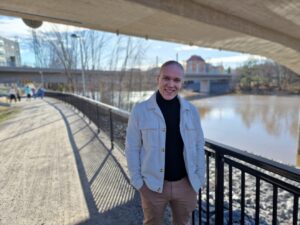
“Burnout is too costly for individuals, working communities and society. According to OECD’s assessment, the cost of mental health problems for our society amounts to EUR 11 billion each year. Political parties are seeking solutions to achieve savings of around this same amount over the coming parliamentary term. As a proper means to stabilise public finances, Akava calls for action to be taken now to promote well-being at work”, emphasises Maria Löfgren, President of Akava.
More and more Akava members report having a high or very high risk of burnout
According to the Akava Works survey on working conditions in 2026, a total of 52% of respondents assessed their own risk of burnout to be high or very high. In 2024, the corresponding share was 38%. This is an increase of 14% in two years. The most harmful loading and stress is caused by concurrent tasks, haste, interruptions and an excessive workload.
“The results of our survey paint a grim picture. The current Occupational Safety and Health Act obliges employers to identify work risks and prevent harmful loading and stress. In practice, however, psychosocial risks are not being identified and managed systematically enough in the workplace. Harmful stress and its management are often viewed as an individual-level issue, even though the causes of the problems are much broader: many factors in the workplace, such as the organisation and management of the work and available work resources play a decisive role”, Löfgren states.
Emphasising problem prevention
“Akava is calling for more specific legislation to prevent psychosocial stress. This means the amendment of the Occupational Safety and Health Act and issuance of a decree on psychosocial load factors. The decree has been prepared by the Ministry of Social Affairs and Health, and we believe it should be implemented during this Government term. This would enable us to clarify existing obligations in order to effectively prevent harmful loading and stress, and to address problems at an early enough stage”, Löfgren says.
“If you only react when an employee is already burnt out, it’s far too late. The resulting costs are higher for both the individual and the workplace as well as for society. More than six million workdays a year are lost due to absences caused by mental health issues, and the annual cost of these absences is between EUR 1–2 billion”, Löfgren adds.
“Promoting well-being at work is a good growth policy, since sustainable economic growth is built on people’s work ability, competence and adaptability. By investing in well-being at work, we are simultaneously preventing problems and investing in productivity and sustainable growth”, Löfgren emphasises.
Statistics on burnout and mental health disorders in 2025
- According to the Finnish Institute of Occupational Health, there were more than 750,000 days of work absence caused by burnout, the social cost of which is estimated to be EUR 260 million.
- More than 100,000 people received Kela’s sickness allowance due to mental health disorders.
- Approximately 97,000 people were on disability pension for mental health reasons. They represented 55% of all disability pension recipients. These disability pensions for mental health reasons cost Finland approximately EUR 1.35 billion.
Campaign on workload risks
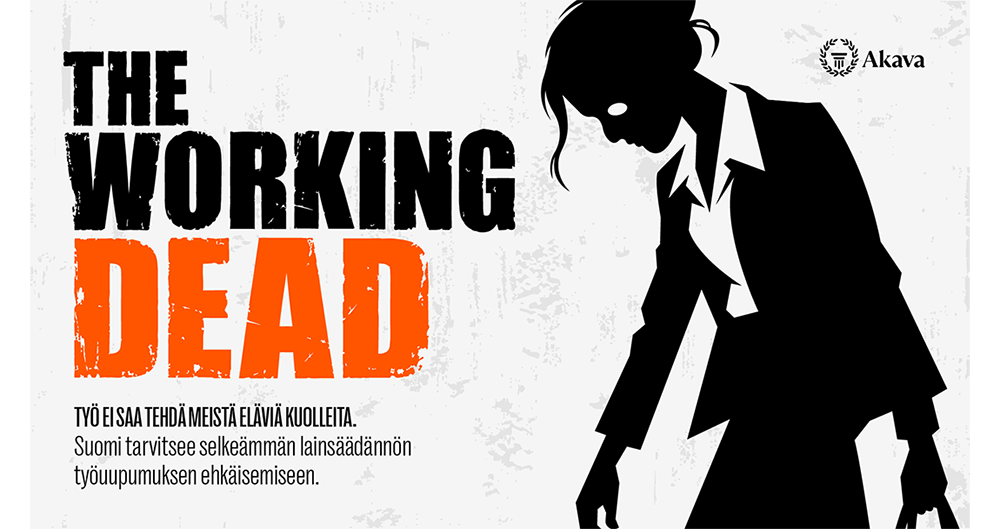
From 11–25 November, Akava is running a campaign entitled ‘The Working Dead’, which emphasises the importance of ensuring that work is not turning us into the living dead. Read more about the campaign at https://akava.fi/workingdead/
See the results of Akava Works survey on working conditions in 2026 https://akavaworks.fi/kysely/tyoolotutkimus-2026/
Further information
Maria Löfgren, President of Akava, tel. +358 (0)40 568 2798Aloita kirjoittamalla tähän kappaleen sisältö